 A recent caller on our Wacky Wednesday radio show asked whether it’s safe for Catholics to eat halal food. The best answer we can give is – it all depends.
First, it’s important to understand that halal, a word that means permissible, is any food that has been manufactured or produced using utensils and equipment that have been cleaned according to Islamic shariah law, and that do not contain specifically prohibited foods such as pork, carnivorous animals, blood, and alcohol. Non-food items like cosmetics or pharmaceuticals are generally considered to be halal unless they contain animal by-products that were not procured according to Islamic law, or that contain forbidden substances.
Halal requires animals for food to be ritually slaughtered (dhabihah). Animals are to be healthy and alive, slaughtered by a Muslim in the name of Allah with a swift cut to the jugular vein to bring about a swift and painless death and to insure complete blood drainage. These animals are to be raised with care and are not to be forced to see other animals being slaughtered. While this method of slaughter is very humane, the rituals that attend these slaughters are where the problems arise.
As Father John Zuhlsdorf, author of the popular Father Z blog, points out in this blog, “[T]here is always a prayer pronounced over the animal while killing it. The prayer to be recited is ‘Bismillah allahu akbar… In the name of allah; allah is the greatest.’ If the name ‘allah’ is accidentally omitted the meat might be permissible. If purposely omitted it is haram, forbidden. Slaughtering in the name of any other god is forbidden.”
This is a problem for Christians. St. Paul warns in 1 Corinthians 10 that Christians, who are partners in the altar where the body and blood of Christ are offered, should not eat food offered to idols.
Paul said in 1 Corinthians 10: “Therefore, my beloved, shun the worship of idols. . . Consider the people of Israel; are not those who eat the sacrifices partners in the altar? What do I imply then? That food offered to idols is anything, or that an idol is anything? No, I imply that what pagans sacrifice they offer to demons and not to God. I do not want you to be partners with demons. You cannot drink the cup of the Lord and the cup of demons. You cannot partake of the table of the Lord and the table of demons.”
However, as Father Z points out, the Catechism (No. 841) seems to say that Muslims worship the same God of Abraham as Christians and Jews, so you would not be partaking of the table of an idol.
But he goes on to posit another position. “According to Islam, Mohammed was visited by supposedly Gabriel. However, what Gabriel told Mohammed contradicts what we know the Archangel Gabriel told Mary. Hence, we must conclude that a false ‘gabriel,’ a fallen angel, visited Mohammed. In that case is ‘allah’ the same as the Christian/Jewish God? The 1st Commandment of the Decalogue forbids us to partake in false religions. As a Christian, I contend that Islam is a false religion.”
Therefore, “if ’allah’ really is a false god and not, in fact, the same God of the Jews and Christians, then eating halal meat, ritually slaughtered in the name of a false god, violates what Paul said in 1 Corinthians.”
St. Paul also reassures the people that because “an idol has no real existence” and “there is no God but one” (1 Cor 8:4), if it should be served to us in a restaurant or purchased unawares in a grocery store, the meat itself is not a problem. What matters is whether or not you know it’s halal.
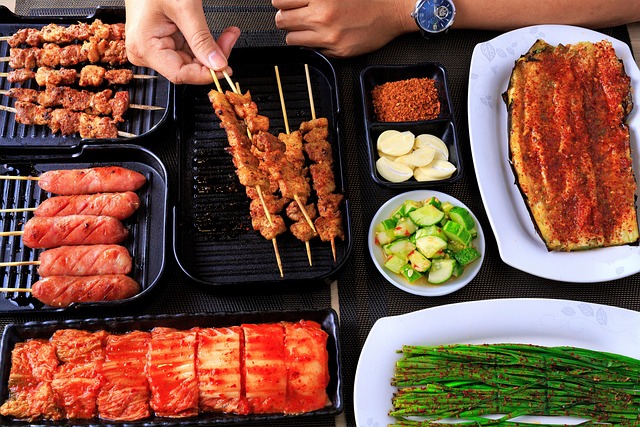
He uses the example of a barbecue where the host is grilling meat, some of which is halal. When it’s done, he simply calls his guests to “come and get it” and they all pray, “Bless us O Lord, and these thy gifts . . .” This scenario would probably be acceptable.
However, if the host said “This is halal meat, which was killed in the name of Allah,” that’s a different story.
“That seems to me to be, by intention, an extension of participation in a false religion,” Father Z. states. In that case, “To be on the strict side, avoid halal meat if possible.”
© All Rights Reserved, Living His Life Abundantly®/Women of Grace® http://www.womenofgrace.com