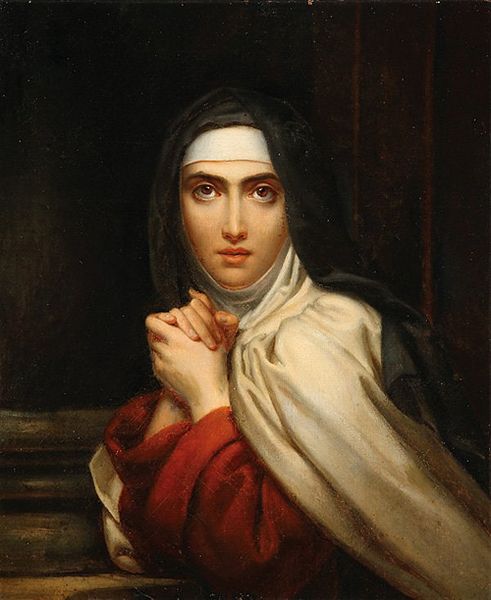
 New Age mysticism is always looking for credibility, especially among the lucrative Christian market, and they are not above misappropriating our saints, especially the giants of Christian mysticism such as St. Teresa of Avila.
One of the most revealing examples of how New Agers try to misappropriate our saints can be found in the book, Entering the Castle, which puts a New Age spin on the Catholic classic, The Interior Castle by St. Teresa of Avila. Written by Caroline Myss, who refers to herself as a medical intuitive, a person who claims to use psychic powers to diagnose illness, Myss uses the same tactics as others have done with our saints, such as St. Michael and St. Hildegard, and keeps Teresa’s language about interior transformation and union with God but detaches those concepts from the Catholic theology that gives them meaning.
Our first clue about the dubious nature of this book comes from Myss’ claims to have received the idea to write the book from St. Teresa herself. As she describes in the book, she was teaching a workshop on Christian mystics and accidentally picked up Teresa's Interior Castle instead of St. John of the Cross's Dark Night of the Soul. As she was introducing Teresa to the class, she suddenly felt a presence near her, then heard the words, “Daughter, follow me.” She immediately believed this to be the voice of St. Teresa and decided to write a book based on The Interior Castle. When she received a bookmark in the mail containing the famous Teresian quote, "Let nothing disturb you. God alone suffices," she believed this to be a confirmation of the project.
If one is familiar with the writings of St. Teresa, it would seem hardly possible that she was involved in a book that combines Eastern and Western mysticism with the psychology of consciousness. Rather than discovering the merits of self-knowledge in one’s pursuit of union with God as Teresa taught, Myss’ version is all about discovering aspects of the Self in order to encounter one’s own “organic divinity.”
She goes on to insert energy fields into Teresa’s teachings by correlating the seven mansions with the seven chakras of Hindu-derived energy spirituality. As she says, “Your chakras are to your energy system as our mansions are to your soul.”
A published analysis of Myss's teachings cites a 2009 Wisdom University seminar in which she reportedly drew an explicit parallel between progression through the mansions and progression through the chakras. She associates the lower mansions with concerns such as physical and material power with more advanced spiritual development reserved for the higher mansions.
Compare this to Teresa's version. In the first three mansions, the soul struggles to overcome sin, worldly attachments, and self-love while growing in humility, self-knowledge, and virtue. In the fourth mansion, the soul begins to experience infused contemplation, including the Prayer of Quiet, in which God's action becomes increasingly prominent. The fifth mansion introduces the Prayer of Union, while the sixth is marked by spiritual betrothal, profound trials, and extraordinary mystical graces. Finally, in the seventh mansion, the soul receives the grace of spiritual marriage, or transforming union with God. Throughout this journey, it is not the soul's manipulation of hidden energies that brings about spiritual progress, but God's grace transforming a soul that has surrendered itself to Him.
Myss' descriptions bear little resemblance to the truths Teresa taught. Instead, she superimposes concepts from energy spirituality onto Teresa's profoundly Catholic understanding of the soul's journey toward God. By correlating the seven mansions with the seven chakras—energy centers whose existence has never been scientifically established—Myss transforms a masterpiece of Christian mysticism into something Teresa herself would scarcely recognize.
While Myss’ book focuses entirely on the Self, Teresa’s is wholly focused on God. The differences could not be more obvious.
In fact, while speaking at an International Teresian Congress in 2011, Bishop Cecilio Raúl Berzosa Martínez of Ciudad Rodrigo described Teresa’s writings as “keys or antidotes to confront the mystical deceits of the New Age,” particularly that of pantheism and the pretentions of being able to save oneself.
As Pope Benedict XVI enunciated so brilliantly during an audience, Teresa of Avila “is a true teacher of Christian life for the faithful of every time. In our society, which all too often lacks spiritual values, St Teresa teaches us to be unflagging witnesses of God, of his presence and of his action. She teaches us truly to feel this thirst for God that exists in the depths of our hearts, this desire to see God, to seek God, to be in conversation with him and to be his friends.”
What Myss’ book makes painfully obvious is that the numerical similarity between the seven mansions and the seven chakras does not establish a spiritual equivalence.
Instead, the number seven is about the only thing the two books have in common.
© All Rights Reserved, Living His Life Abundantly®/Women of Grace® http://www.womenofgrace.com
Send your New Age questions to newage@womenofgrace.com