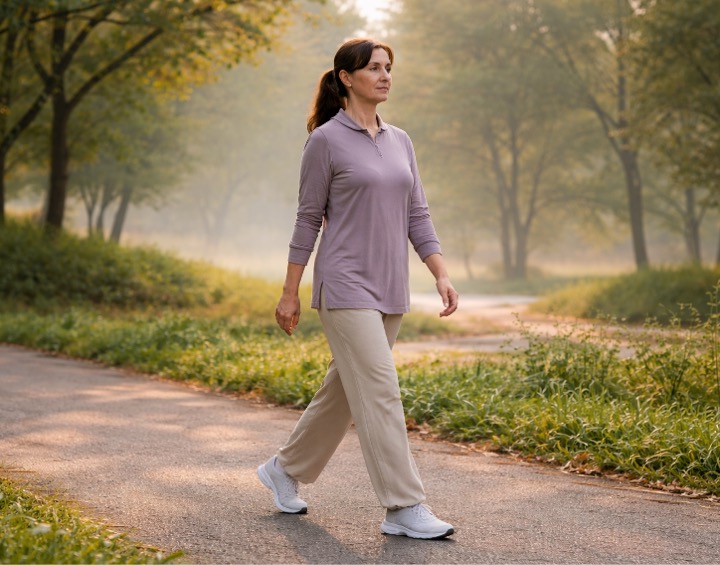
 JJ asks: “Walking Tai Chi is all over social media. Is this really tai chi and is it okay for Catholics?”
I have seen these ads on TikTok and they have certainly contributed to making Walking Tai Chi the next big exercise fad with roots in Eastern spirituality. Whether or not Catholics can participate depends upon certain factors.
For those who never heard of it, Walking Tai Chi is a simplified practice derived from traditional tai chi that focuses almost entirely on slow, mindful stepping rather than the full sequence of forms as found in the traditional version. Walking tai chi keeps the core principles of Tai Chi but without all the choreography.
Those core principles are based upon the belief that tai chi helps the flow of a universal energy force known as “qi” that supposedly regulates a person’s body, mind and spirit. Qi must be able to move freely for good health. Tai chi also aims to harmonize yin/yang, which are believed to be two opposite and complementary forces in the universe.
The various motions of tai chi are designed to imitate motions found in nature, such as the movements of animals, thereby uniting human beings with the natural world. These motions involve coordinated arm movements, the shifting of weight from leg to leg, rotational movements of the torso and deep diaphragmatic breathing, all in a rhythmic, unbroken flow.
Walking tai chi simplifies this by focusing on just one aspect of tai chi – the rhythm motion – which is that of walking in a very slow, heel-to-toe stepping pattern. This involves an upright posture, relaxed shoulders, natural breathing, conscious weight-shifting and awareness of balance.
It’s important to note that the Chinese philosophical system of yin-yang, qi, and meridian theory are present, even in simple walking practices, which are believed to circulate qi, open meridians and harmonize internal energy. If kept in its original framework, even the slow-stepping style of walking tai chi is considered to be energy work which is a concept that is not compatible with Christianity.
However, here’s where the caveat comes in. The walking tai chi we see on social media may or may not contain these problematic elements. Those found in senior centers and physical therapy sessions rarely contain the philosophy of qi but are framed in more medical terms such as fall prevention, balance training, neuromuscular control, etc. So it all depends on the instructor and the philosophical framing of the class.
Unlike yoga where many of the asanas are founded in the worship of Hindu deities, tai chi motions do not have these more problematic associations. Therefore, the danger in walking tai chi would be in the philosophy rather than the movements, which means a Catholic could participate in the practice provided they are doing so purely for the health benefits. The movement itself (walking) is not a risk as it would be in yoga (asanas).
The only risk in engaging in walking tai chi would be if it inspires a desire to engage more fully in the practice of tai chi, which would involve a deeper immersion into the philosophy behind it which is not compatible with Christianity.
© All Rights Reserved, Living His Life Abundantly®/Women of Grace® http://www.womenofgrace.com
Send your New Age questions to newage@womenofgrace.com.