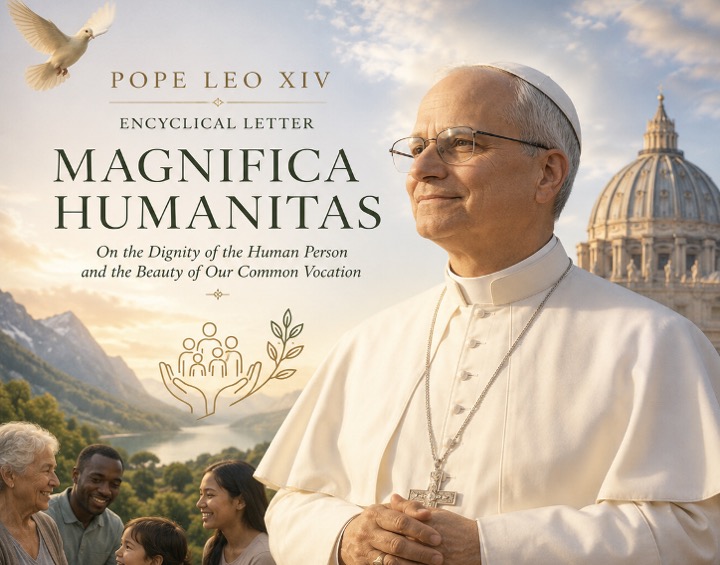
 Since the start of his pontificate, Pope Leo XIV has been warning the faithful about the dangers of the unchecked development of artificial intelligence which is why it is no surprise that his first encyclical would be focused on this subject.
According to the Catholic News Service (CNS), Magnifica Humanitas: Safeguarding the Human Person in the Time of Artificial Intelligence, is an 82 page encyclical that “significantly boosts the Catholic Church's position as an active voice in discussions over artificial intelligence, autonomous weapons, labor, human dignity and the concentration of technological power among a handful of corporations.”
In the May 25 unveiling of the document in the Vatican’s Synod Hall, the Pope said, “Peace, not merely the absence of war, is justice at work. But when technology weakens our critical sense, peace itself is at risk.”
Even though the document acknowledges the many benefits of artificial intelligence (AI), the Pope was adamant when saying this developing technology needs more scrutiny.
"Artificial intelligence needs to be disarmed," the pope said. "The word is strong, I know, but deliberately chosen because this moment needs words capable of attracting attention, awakening consciences and indicating paths forward for humanity."
The document, which was issued on the 135th anniversary of Pope Leo XIII’s landmark encyclical, Rerum Navarum, which affirmed the dignity of work and denounced the tenets of socialism, begins by laying out the moral groundwork that must underlie AI, stressing the importance of the right to private property and how it must be subordinate to the common good, and how we are not just an aggregate of individuals, but are interconnected in responsibility for the commonwealth. Under the principle of solidarity, we must handle our civic duties at the level closest to the individual which forms communities and associations that protect society against the centralization of power. Last, he couples human rights with human dignity, the first of which is the right to life, specifically citing abortion and euthanasia as contrary to human dignity and a violation of human rights.
From there he begins to list the dangers of AI:
Risk of Dehumanization
The Pope’s first warning concerns the “risk of dehumanization – of building a future that excludes God and reduces the other to a means” (No. 10) in which persons are treated as data. By addressing this danger first, the Pope is framing the deepest danger of AI morally rather than technically, framing it as the temptation to reduce human beings to productivity or utility. This would violate Church teaching that the human person is always an end in himself/herself, never merely a means.
Technological Messianism
Another danger is how the availability of AI can create the illusion that we can perfect ourselves with technology in a kind of technological messianism.
“The human desire for fullness of life is at risk of being misled by deceitful goals… a technology that promises to free us from all weakness” (No. 12). In Catholic anthropology, suffering, limitations, vulnerabilities, are not defects to erase but dimensions of human maturity and grace.
Loss of Human Identity
AI also threatens us with the loss of human identity. In a statement which may well become the encyclical’s thesis statement, he writes: “In the era of artificial intelligence, when human dignity is threatened by new forms of dehumanization, ours is the pressing duty to remain profoundly human” (No. 15). The answer to this is not withdrawal or fear, but increased cultivation of relationships, conscience, listening to others, compassion and communion.
Formation of Technocracies
Another serious danger is allowing for a kind of technocracy to form in which technology becomes “the standard by which everything is judged,” reducing “human beings to mere cogs in a system driven toward ever greater efficiency.”
Anthropomorphizing of AI
In addressing one of the more unnerving aspects of AI, Pope Leo warns that AI is not human intelligence.
AI systems “do not possess a body… do not mature through relationships… [and] do not have a moral conscience” (No. 99). This anthropomorphizing of AI can lead to moral confusion.
The pope sharply distinguishes machine processing from human wisdom. While AI may imitate empathy or intelligence, it lacks conscience, a living experience, moral responsibility and the relationship depth through which persons mature.
Further addressing this danger, the pope cites the danger of AI creating “the illusion of a relationship with a real personal subject” (No. 100). This can lead to counterfeit relationships and, consequently, isolation. Worse, it can lead to the weakening of the desire for authentic human relationships, particularly among those who are emotionally vulnerable.
Misinformation and Erosion of Truth
“Disinformation did not begin with AI, yet today it finds a powerful amplifier in AI” (No. 132).
This is precisely what has led to the rise of deepfakes and other forms of manipulation and promulgation of misinformation. The Pope sees truth as a common good and warns against AI’s ability to distort narratives, manipulate images and videos, and confuse fact with opinion which undermines trust.
Weakening of Democracy By Indifference to the Truth
“Indifference to the truth leads, slowly but surely, to a descent into totalitarianism.” (No. 134) This results in the democratic decay and social fragmentation. The pope warns that once people stop caring about the truth, manipulation becomes easy.
In his praise of the document, Catholic League President Bill Donohue applauds the pope for admonishing us “not to allow AI to transform us into a new form of slavery. We are being reduced to ‘data’ that allows us to be tracked and treated as ‘packages’ to be moved around with abandon. It is not enough to ‘invoke efficiency,’ especially if it results in a ‘chain of exploitation.’”
He adds: “Science tells us what we can do. It does not tell us what we should do. This powerful encyclical should reach an audience well beyond the Catholic community. Pope Leo XIV has given us much to weigh.”
© All Rights Reserved, Living His Life Abundantly®/Women of Grace® http://www.womenofgrace.com