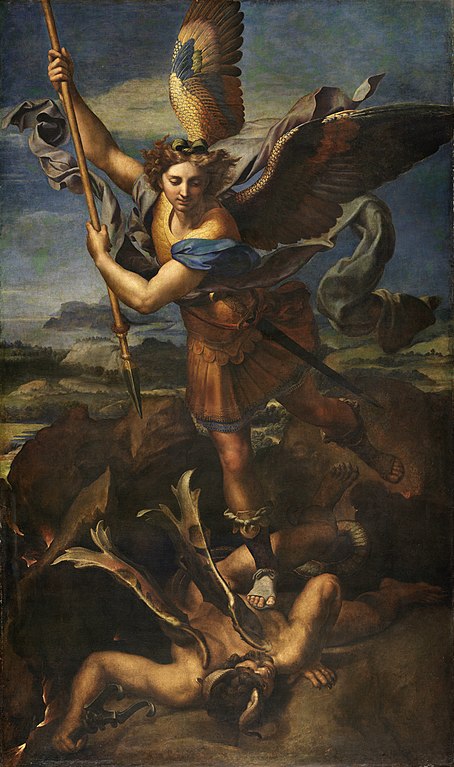
 BB writes: “There’s a lot of confusion about the various St. Michael Prayers and which ones lay people can use. Can you clarify this for us?”
Great question!
There are four versions of the St. Michael prayer.
First, there is the short prayer to St. Michael Prayer. This is the one best known to the faithful and typically prayed publicly at the end of every Mass. It was introduced by Pope Leo XIII in 1886 after his famous vision where he saw Satan attacking the Church.
Second is the long version of the St. Michael Prayer, entitled “Exorcism Against Satan and the Apostate Angels.” This was published in the 1890-91 edition of the Acta Sanctae Sedis and is the exclusive formula for bishops and priests authorized to perform exorcisms.
In spite of widely circulated claims on the Internet that the restrictions on the long version were lifted, as per this article on ePriest, this is not true. They have remained in force from the very beginning and remain in effect until today.
“1. Canon 1172 of the Code of Canon Law states that no one can legitimately perform exorcisms over the possessed unless he has obtained special and express permission from the local Ordinary (§ 1), and states that this permission should be granted by the local Ordinary only to priests who are endowed with piety, knowledge, prudence and integrity of life (§ 2). Bishops are therefore strongly advised to stipulate that these norms be observed.
“2. From these prescriptions it follows that it is not even licit that the faithful use the formula of exorcism against Satan and the fallen angels, extracted from the one published by order of the Supreme Pontiff Leo XIII, and even less that they use the integral text of this exorcism. Bishops should take care to warn the faithful, if necessary, of this.”
The reason for this plea to instruct the faithful was given by the International Association of Exorcists in a 2020 note:
“We point out, on the basis of common exorcistic experience, that the illegitimate and improper use by priests and lay faithful of every exorcistic formula reserved for the liturgical sphere, including the exorcism of Leo XIII, can have more or less serious spiritual consequences, including occasionally becoming the cause of extraordinary diabolical disturbances.”
Third, there are redacted versions of the long St. Michael prayer, such as the one included in the book, Deliverance Prayers for the Laity by exorcist Father Chad Ripperger, but these do not contain formulas reserved for bishops and exorcists, and can therefore be used licitly and without retaliation. However, one should only use those versions redacted by competent authorities.
A fourth version of the St. Michael Prayer, known as the Leo XIII Minor Exorcism, includes formal exorcism formulas such as “I exorcise you . . .” and “Be uprooted and driven from the Church of God . . .” Because this prayer specifically includes direct commands to demons and authoritative adjurations, it becomes an official act of the Church’s authority and is therefore not for use by the laity.
In this interview, Fr. Ripperger explains what can happen to people who use the restricted long forms or other questionable derivatives. “. . .I know laity that have used it, and they end up with this problem of retaliation. Very often they’ll say, ‘well I’ve used it and I’ve never suffered any problem’ and you’ll ask them well, what’s your family life like and then you’ll find out that . . . there’s all this collateral damage in their family, and so that’s one of the signs that they’re biting off a bit more they can chew.”
Because of the danger of retaliation when attempting to command Satan outside of the authority established by the Church, it is highly recommended that one use the most commonly known version. This powerful deprecatory prayer calls upon St. Michael to “defend us against the devil.” Demoniacs claim it is torturous for demons to endure.
In an exorcism case handled by exorcist Monsignor Stephen Rossetti, a demoniac named David described what he heard when this particular prayer was recited.
"When they say the St. Michael prayer, I can hear the demons screaming. It's so horrible and frightening and painful."
St. Michael would not want you to invoke him in a way not prescribed by the Church and that could result in harm to your or your loved ones. Recite the proper prayers with integrity of heart and his response will be as great as it needs to be.
© All Rights Reserved, Living His Life Abundantly®/Women of Grace® http://www.womenofgrace.com
Send your New Age questions to newage@womenofgrace.com